The MCP Model Works. The Tracking Shouldn't Be the Bottleneck.
If you are reading this, you probably do not need convincing that self-paced, mastery-based instruction works. You have read Barnett's book, or done the Modern Classrooms Project Virtual Mentorship, or watched a colleague's class run itself while you were still stuck in Initiate-Respond-Evaluate cycles.1 You have restructured your classroom around video direct instruction, mastery checks, and a pacing calendar. On a good week, you can feel it working.
The thing nobody tells you before you start: running a Modern Classroom is operationally heavy. Tracking ninety students across three tiers, with five possible statuses each, on a pacing calendar that updates every day, turns into a spreadsheet problem that eats your Sunday nights. The pedagogy is sound. The tracking is what burns you out, and burnout is usually what kills the model at your school, not whether the approach works.
The model works. The research is clear.
You already know this. But in case you ever need the receipts for a skeptical principal, the research on mastery-based and self-paced learning has been stacking up for decades, and the Modern Classrooms Project has independent evaluation data that is hard to argue with.
9x more likely to catch up absent students
Teachers running the MCP model report significantly higher capacity to serve students at all levels and help absent students catch up, per Johns Hopkins CRRE's independent evaluation.2
Roughly 0.5 SD gain in mastery learning
A meta-analysis of 108 controlled evaluations found mastery learning programs raise exam scores by about half a standard deviation, with stronger effects for struggling students.3
So the model is evidence-backed, and the MCP community has built a strong practitioner base around it. The question for teachers running it isn't whether to adopt. It's whether you can sustain the operational load long enough for the pedagogy to do its work.
The gap between pedagogy and logistics
Every self-paced mastery teacher runs into the same three operational problems within the first month. None of them are pedagogical failures. They are logistics failures, and they start to undermine the pedagogy if you do not get ahead of them.
- Tracking where every student is, every day. Not just the unit, but the specific lesson, the specific tier, the specific status. You can do this in a spreadsheet. You can do it for three weeks. Then the maintenance overhead starts winning.
- Catching the student who has been "In Progress" on lesson 3.2 for eight days. The whole point of a pacing calendar is to spot drift early. But spotting drift requires scanning every row of your tracker, every day, in a classroom where you are also teaching and running mastery checks.
- Making progress visible to students so they own it. If the only person who knows where anyone is in the unit is you, students drift by default. Self-pacing only works when students can see the goalposts and their own position relative to them.
MCP's pacing calendar templates and mastery trackers are well-designed. They work on paper. But they are usually implemented as spreadsheets the teacher maintains by hand, and the spreadsheet is the bottleneck that determines whether you sustain the model over a full year or quietly revert in February.
What a purpose-built tracking layer looks like
PrepPanel's Self-Paced Learning Roadmaps were designed around the shape of the MCP model, not adjacent to it. The goal is to cover the tracking and visibility layer completely so you can focus on instruction and mastery checks, the parts that actually require you.
Your tier labels, not ours
PrepPanel ships with Learn, Grow, Challenge as defaults, but every tier name, color, and description is fully customizable. If your classroom runs on Must Do, Should Do, Aspire to Do, use that. If your school uses Foundation, Application, Extension, or Essential, Enrichment, Honors, use that. The three-lane architecture is what aligns with the MCP model.1 The labels stay yours, which means your existing unit plans and student-facing vocabulary drop in with zero translation.
A per-student status flow that honors the mastery check
Each activity moves through five states for each student: Not Started, In Progress, Ready for Check, Complete, and Catch Up Needed. The one that matters most is "Ready for Check." That is the mastery check queue, which is the real choke point of every MCP classroom. When a student marks themselves Ready for Check, you know who is waiting on you, and students know they are not forgotten.
Any status can drop to Catch Up Needed if a student misses an on-pace checkpoint. That is the flag PrepPanel raises automatically.
On-pace dates, not deadlines
Following MCP language, dates are checkpoints, not hard deadlines. Students who miss a checkpoint get flagged as Catch Up Needed. The flag is a signal, not a punishment, and it gives you the early-warning system that usually lives in your head or on a sticky note.
Auto-detected Catch Up Needed
The thing you currently do on a Sunday night, scanning every row to see who has not moved, PrepPanel flags for you. You still decide what to do about it. The tool does not intervene. It just makes sure the student who quietly stalled does not stay invisible.
A live projected pacing board
This is the piece most teachers do not know they need until they try it. A public pacing board displays through the side panel to the whole class. Students see their own progress and their classmates' status. When a student finishes an activity, they walk up to the board and change their status right there. No phones, no logins, no apps. If you use PrepPanel's optional Remote feature, those status changes also appear live on your laptop in real time from anywhere in the room. The pacing board becomes the ambient backdrop of the class, not something only you see.
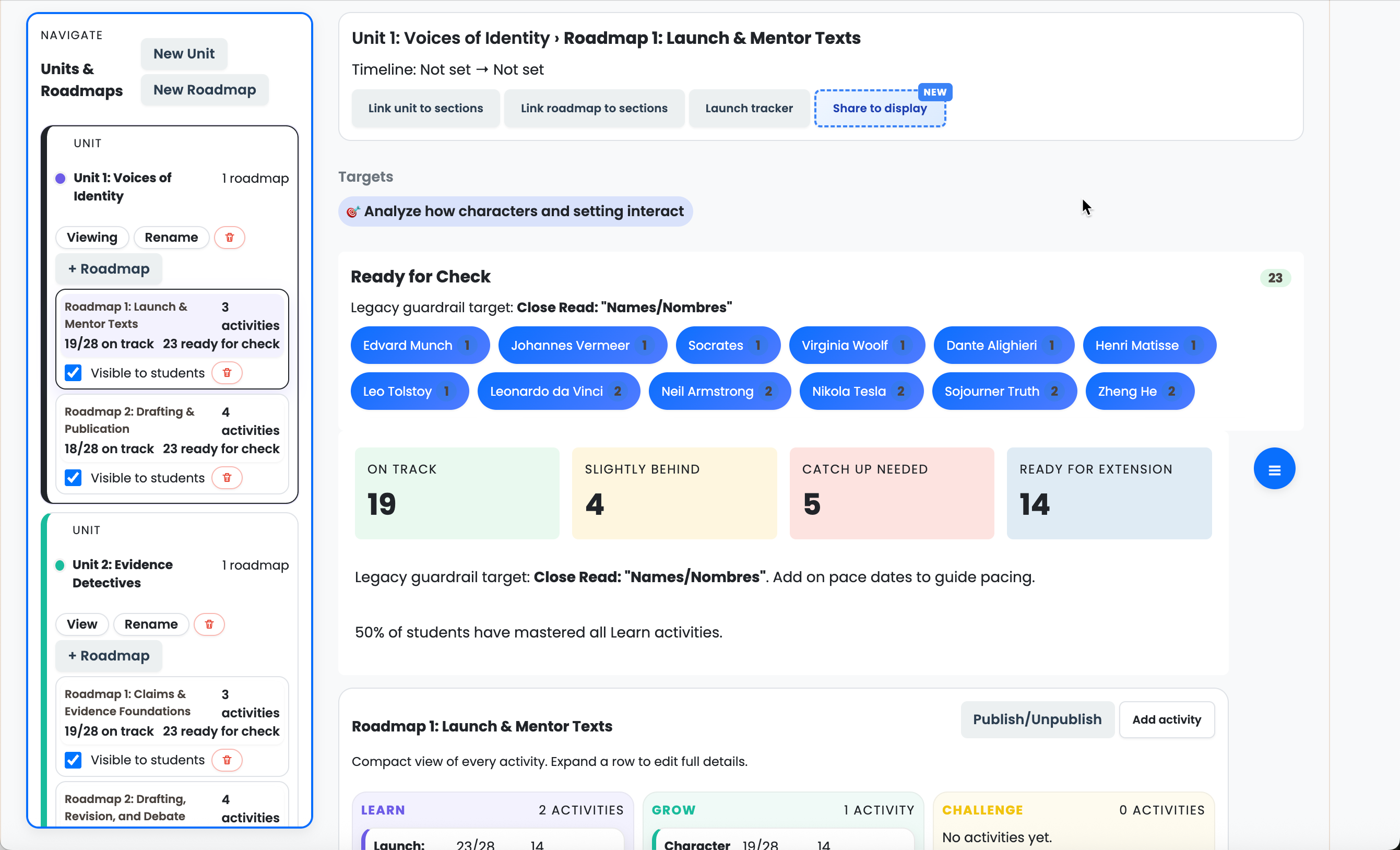
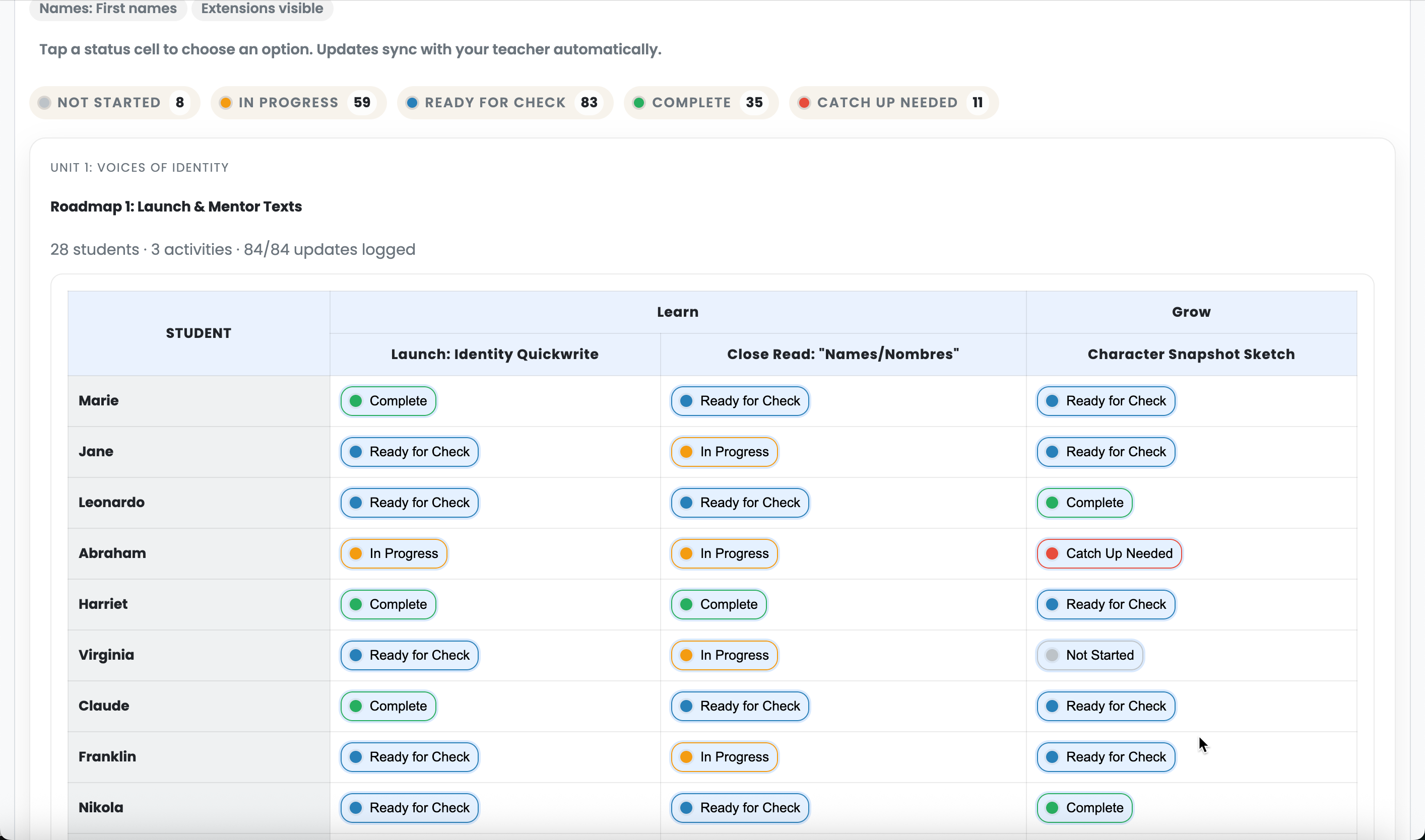
For a full walkthrough of the pacing feature, see the Pacing Roadmaps how-to guide →
If you are heading into Year 2 of MCP
If you survived Year 1 on spreadsheets, you already know the sustainability question. Year 2 is when the logistics either become a system you can maintain or quietly become the reason you step back to a traditional model. Hand off the tracking early.
The honest bottom line
PrepPanel does not deliver your content. It does not host your videos or run your mastery checks. It does not grade. That is still you, your LMS, your instructional design, and your expertise. What PrepPanel handles is the tracking and visibility layer, the part that burns you out without adding educational value.
If you are trying to sustain a Modern Classroom over years, not semesters, that is probably the part you most need to hand off. The pedagogy stays yours. The spreadsheet does not have to.
The MCP model does not fail because it is wrong. It fails when teachers burn out on operational load before the pedagogy has time to do its work.
Tools that share the load are how you sustain the model through April, not just through November. Keep the pedagogy. Hand off the spreadsheet.
References
- Barnett, R. (2025). Meet Every Learner's Needs: Redesigning Instruction So All Students Can Succeed. Jossey-Bass. Publisher page
- Center for Research and Reform in Education, Johns Hopkins University. (2021). The Modern Classrooms Project: Evaluation Results for the 2020-21 School Year. PDF
- Kulik, C. L. C., Kulik, J. A., & Bangert-Drowns, R. L. (1990). Effectiveness of Mastery Learning Programs: A Meta-Analysis. Review of Educational Research, 60(2), 265-299. Journal article
- Bloom, B. S. (1968). Learning for Mastery. Evaluation Comment, 1(2), 1-12.
- Guskey, T. R. (1996). Implementing Mastery Learning (2nd ed.). Wadsworth.